Blog

You Are Related How?

Understanding How You Are Related To Everyone In Your Family Tree

Have you ever had a conversation with someone where you were trying to explain to them how you were distantly related to someone? I’m talking about someone other than your mother, father, sister or brother.  When talking about our relatives we commonly use the titles of cousin, aunt, uncle, grandparents, great grandparents, but when talking about someone who is very distantly related it can get a little tricky, so we try to explain using as much detail as possible. We may say “he is my father’s brother, my uncle Tom’s daughter, Karen’s grandson Michael”, which is quite lengthy and can be somewhat confusing. It would be easier to say Michael is my first cousin twice removed on my father’s side, which has the same information, but less confusing.

The level or the degree of a cousin’s relationship is based on the most recent direct ancestor that the two of you have in common. So let’s start with our closest and most direct cousin and work our way back.

Who is Your First Cousin?

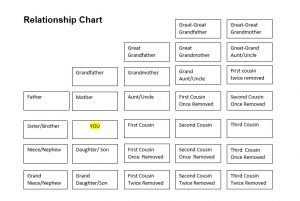
Your First Cousin is a child of your aunt or uncle, also known as your parent’s niece or nephew.  This person is considered to be your first cousin. You share one set of grandparents with this cousin, but you do not share the same parents. Look at the chart below and find yourself (You) and then find your first cousin. That is pretty straight forward relationship.

What makes them a Second Cousin?

Your second cousin is the grandchild of your grand-aunt or grand-uncle, also known as the child of your parents’ first cousin and you share the same set of great-grandparents with your second cousin. You do not have the same grandparents though.  Their grandparents are your grandaunt and granduncle. More commonly, many people use great aunt or great uncle, but technically they are grandaunt and granduncle. They are the siblings of your grandparents. Look at the chart below and find yourself and then find your second cousin.

How about those Third Cousins?

Your Third Cousin are fairly distantly related, but you both share the same set of great-great-grandparents. Your third cousin is the child of your parents’ second cousin. They are the great-grandchild of your great-grand-aunt or great-grand-uncle. You share a set of great-great-grandparents with your third cousin.  As for your Fourth cousin, they share a set of great-great-great-grandparents with you.  Look at the chart below and find yourself and then find your third cousin.

Do You have any Double First Cousins?

Just to complicate matters let’s talk about Double First Cousins. If two siblings let’s say brothers in one family marry two siblings, sisters from another family and each couple has a child, these two children are called double first cousins. The word double in addition to the first cousin term is because they share the same four grandparents. In typical, first cousins share only one set of common grandparents, while double first cousins share both sets of grandparents.

What does the term “Once Removed” mean?

The term “once removed” is used to explain the relationships of cousins of different generations. A cousin who is “once removed” means one generation before or after you. Your first cousin’s child is your first cousin once removed, and your mother’s first cousin is also your first cousin once removed. One was born from the generation after you and the other was born in the generation before.  Removed cousin relationships are measured by the generation difference, not age.

Twice removed means that there is a two-generation difference. As in example above Michael is first cousin twice removed. Your grandmother’s first cousin would be your first cousin, twice removed because again you are separated by two generations.  The person was born two generations after or before you.

Cousin relationships can be any combination of first, second, third etc, and also be once, or twice removed, and so on. Look at the chart below and find yourself and then find a first cousin once removed and a first cousin twice removed.

How is one a Grand or a Great?

Grandparents and great-grandparents are very commonly used titles for the parents and grandparents of our parents. Aunts and uncles become grand when they are the siblings of grandparents, though we rarely call them grandaunts or uncles, we usually call them great aunts and uncles, but technically, your parents’ aunts and uncles are your grand aunts and uncles. The aunts and uncles of your great grandparents would be your great-grand aunts and uncles.

Also, if your niece had a child, it is common for you to say “my niece’s child Amber”, but the child can also be referred to as your grandniece. Your grandniece’s child would be your great-grandniece, this is identical to that of grandchild and great grandchild.

The chart below is an example of the levels/degrees of family relationships This chart serves as a visual to help determine the correct titles of your relatives. ItIt It represents the relationships for either your mother’s or your father’s side of the family.


Here is a pdf copy of the above family relationship chart.  I hope that you now have a clearer understanding of how you are related to the members of your family tree and have an easier way of describing your connection to those relatives. For more helpful genealogy articles:  Ancestryseeking.com


Was He a Builder? a Principal? a Fundraiser? or a Priest?

chagnonfamilytree

 Who is This and How are We Related?

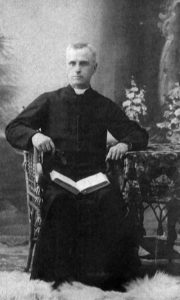
Francis X. Chagnon, was born February  18, 1842 in Vercheres,  a  suburb of Montreal, Qc. He is the son of Moise & Emelie (Provost) Chagnon.
Francis  Chagnon  studied to become a priest at Joliette and  grand seminaries of Montreal and on Jan 30, 1870, at the age of 28, he was ordained a Catholic priest.  He was the Vicar at St Lin,   St. Jacques de l’Achigan,  St. Philomene de Chateauguay, St. Isidore de Laprairie,  St Michel de Napierville,  St Jean  in Iberville and St. Brigide of Montreal  from 1870-1877.
 
Father Chagnon immigrated to the United States in 1877; when he was appointed as pastor of St. Mary Church in Champlain, NY,  on January 6, 1877. He continued to serve  at St. Mary’s Church and its community  for nearly 35 years.
 
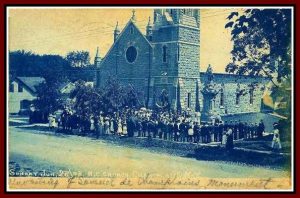
St. Mary’s parish was  financially poor and had  a modest antiquated wooden churcchagnon family treeh. However, the congregation was rich in spirit and determination. Father Chagnon soon led the way in raising money for the construction of a new church which still stands in the village of Champlain, NY today.  Though it was a struggle to raise the money for the church’s construction, the project was completed before the turn of the century. The new church not only gave the congregation a formidable place to worship, but it also earned Father Chagnon great admiration and respect.
St. Mary’s Church was built with Father Chagnon’s strong emphasis on sustaining and promoting the Franco-American culture of the area. Many French came down from Quebec at that time to work in the factories after the Civil War. They were not  always very well-treated and often were looked down upon as foreigners.
 
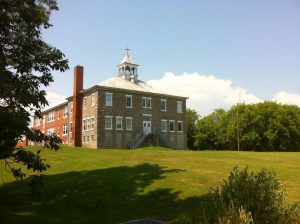
chagnonfamilytreeIn 1906, through Father Chagnon’s efforts, a Catholic school was opened. The Daughters of the Charity of the Sacred Heart of Jesus, who were a group of nuns that came to America from France  came to teach the students.
 
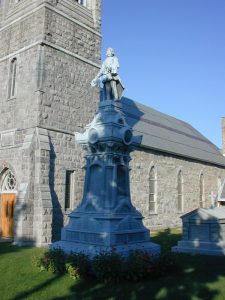
What became Father Chagnon’s most notable accomplishment, was the construction of the monument dedicated to French explorer Samuel de Champlain,  which is the namesake for the village, town and lake, that  divides the states of New York and Vermont.
 chagnon family tree
The town fathers  in Champlain wanted to put up a statue in honor of Samuel de Champlain, but couldn’t come up with the money, so they turned to Father Chagnon. He went all over New England and New York to the French communities, meeting with Franco-American societies, and was able to get them to donate to this statue. The statue was erected  on church property and dedication on July 4, 1907. This was the first statue in the nation to honor Samuel de Champlain.
 
Sadly, Father Chagnon died four years later at the age of 69, on Oct. 10, 1911. He  is laid to rest in a tomb on the church grounds behind the statue of Samuel de Champlain, which is across the street from the former Catholic school  that he had helped establish. 
 
It is said that Father  Chagnon was a very  influential man in the North Country during his time.  And  that his strong vision shaped what the village of Champlain, and particularly St. Mary’s Church, is today. In 2011, the congregation of St. Mary’s Church  honored the 100th anniversary of the death of the Rev. Francis X. Chagnon. The local Knights of Columbus Council bears the name,  the Francis X. Chagnon Council 3525. As you can see Father Chagnon was all of the above, a builder, a principal, a fundraiser, a priest and more.
 
So, how are we related?   Francis X. Chagnon’s grandfather Michel Chagnon  is the brother  of Joseph Chagnon, making Moise Chagnon and  Hypolite Chagnon cousins. Joseph Chagnon is the father to Hypolite. Hypolite is the father of Nazareth (Nazaire) Chagnon.  Nazareth is the father of Narcisse (Nelson) Chagnon. Side Note: Nazareth  immigrated  to  the United States  in the 1860s and lived Champlain, NY. 
(You can see from the  chart below how  Michel and Joseph were brothers, which makes Fr. Francis X. and Nazareth cousins).

Jean Baptist Chagnon/Marie Francoise Pineau

Michel Chagnon/ Veronique Fontaine-Bienvenue Joseph Chagnon / Margaret Lavallee-Paquet
Moise Chagnon/ Hypolite Chagnon/ M. Louise Lamontague-Lalue
 Rev. Francis X. Chagnon Nazareth Chagnon/Euphemia Cusson
Narcisse (Nelson) Chagnon /Delina Bouchard

Is This Our DNA Link To Indian Descendants?

chagnonfamilytreeThe genealogy research took a huge leap forward when the world wide web came into our lives. It has given us the opportunity  to connect to  resources, places, and people  and discover more about our family trees than ever. Now we have even more information since DNA (Deoxyribonulceic acid) came along. DNA  is a molecule that contains the instructions an organism needs to develop, live and reproduce. These instructions are found inside every cell, and are passed down from parent to their children. So how is this information important to linking us to Indian descendants? Can science be more accurate than written documentation? Well, in this particular genealogy research case there are two thoughts (opinions) on this and a lot of information  to back both sides.  So lets look at some of this information and then you decide “Are we linked to an Indian descendant?”

This starts with a person who we will call Catherine P. From documentation it was believed that Catherine’s parents were Pierre Pilet-Pillat Pilliar and Marguerite Morelinet.  But  after  intense research and  using the Mitochondrial DNA (MtDNA)  from  8 of Catherine’s descendants, it has shown that Catherine  may very well not be from French descendant, but from haplo type A, which is only found in the Indian populations. There is documentation that Catherine P (daughter of Pierre Pilet-Pillat Pilliar and Marguerite Morelinet) was baptised March 30, 1646 in Larochelle, France.   It is also known that  there was a Catherine du Plat, who was previously called  Ouenta (daughter of Atsena, Chief of Huron Bear Nation) before she was renamed by her godmother at her christening on  November 25, 1651 and was baptized by Claude Pijart.  Her godmother, Catherine de La Vaux, was the wife of Gilbert Barbier. She was born about June 1651.

So how does this have any connection to  the Chagnon Family Tree?  It is said that a  Catherine P? married Pierre Charron dit Ducharme in the parish of Notre-Dame de Montréal on October 19, 1665 in Montreal, Canada. She and Pierre had 12 children. Their first born was a daughter that they named, Catherine after her mother’s Christian baptized name.  Catherine Charron – Ducharme, the daughter of Pierre and Catherine P? or Catherine du Plat?, the daughter of Chief Atsena,   married Francis Chagnon dit Larose in 1679 in Contrecoeur, Quebec.  Francis was the  first known Chagnon in our family tree  who came to  North America in the mid 1660s as a Carignan Soldier.  So now you know how we are related.

From the DNA and research  it is believed by some that Catherine Chagnon dit Larose’s mother was  “Ouenta du Plat”  the daughter of Atsena, Chief of the Huron Bear Nation, but others believe she is the daughter of Pierre Pilet-Pillat Pilliar and Marguerite Morelinet. As we can see this is where thoughts (opinions) have created a split in the road of genealogy research. So the question is: “who are the true parents of Catherine? Do we believe DNA or the documentation written by several different people over the centuries?

If you are still undecided, you can read more and then decide  who you think we are related to, the Charrron-Ducharme branch or  Atsena, Chief of the Huron Bear Nation branch.
If you are interested in learning more about DNA, go to read my blog on: https://ancestryseeking.com/2017/09/19/how-can-dna-technology-help-find-the-missing-link-in-your-family-tree

Who Is This? And How Is He Related To Us?

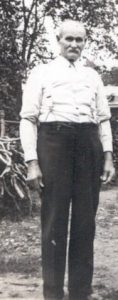
chagnonfamilytreeWho is this? This is Louis Bouchard. He  was born September 18, 1850 in St. Paul’s  Bay, Quebec. The son of Thomas Bouchard and Luce Sauliner. He immigrated to the US in 1870.  Louis was in business for himself, selling wood and coal from the back yard of his home  at  200 N. Champlain Street in Burlington, VT.

chagnonfamilytree
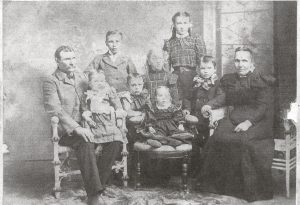
This is Louis with 4 of his children from his 1st wife, Jennie. Starting at the left is Delina, David, Louis, Louis H., and Marie. Taken in 1909.

Louis met and married Delia Jennie Plant on September 5, 1871 in Richmond, Vt.,  Jennie was born in 1850 in Bolton, VT. , she was the daughter of Peter Plant and Anna Brown .

Louis and Jennie had 7 children, 2 daughters and 5 sons. Of the 7 children, they had a set of twins Willie and Willard who died shortly after their births in 1879. On October 20, 1883 Jennie died from consumption at the age of 31.
At the time of Jennie’s death, Delina Bouchard who was the  7th child born was 2-1/2 years old.

Louis met and married Louise Morrow in Winooski, VT on August 18, 1884. Louise was born July 1860 in Lewiston, NY., the daughter of John Morrow and Florence Plant. 

chagnonfamilytree
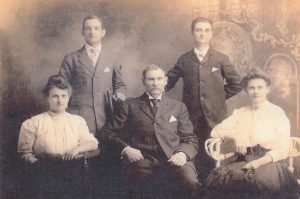
This is Louis with his 2nd wife, Louise. This was taken between 1898-1899. Starting from left Louis with Thomas, Leonard, Paul, Sophia, Clara, Mary, Gilbert and Louise.

Louis and Louise had 14 children, they had 7 daughters and 7 sons. They also had a set of twins, Gilbert and Edward in 1892. Louise died April 15, 1907 at the age of 47.  Their daughter Matilda was born and died in September of 1906. At the time of Louise death, Ernest was 2-1/2years old.

Louis remarried for a 3rd time, August 22, 1909, to Josephine Pollander  in Montreal, Canada. Josephine was born August 1, 1864 in Salem, NY., the daughter of Narcisse Pollander and Josephine Bonville. Louis was also Josephine’s 3rd husband.  

Louis died  at the age of 87  at the Degoesbriand Hospital, Burlington, VT  following a lingering illness. He is buried with his 2nd wife Louise in the Mt Calvary Cemetery in Burlington, VT

chagnonfamilytree
This is Louis, Josephine, and grandchildren standing in Louis’ wood yard.

His 3rd  wife, Josephine  remarried for a 4th time in 1941, three years after Louis’ death. 

 Out of 21 children, 14 children were living at the time of his death.  Those children were: Mrs. Marie Ryan, Edward D., Leonard & Clara Bouchard, all  who were living  in Rochester, NY. Mrs. Roy (Mary) Tremblay, Paul & Thomas Bouchard,  all were living in  Tampa, Fla., Mrs. James (Flora) Steele of Bellows Falls, VT. Mrs. Edward (Sophie) Dorey, Mrs. Nelson (Delina) Chagnon and Leo Bouchard, were  all living in Burlington. Ernest Bouchard was living in Boston, MA and Gilbert Bouchard was living in Los Angeles, CA. There was several grandchildren, and great grandchildren. 

So how are we related? Well you may have figured it out, through Delina Bouchard. Delina married Naricisse (Nelson) Chagnon at the age of 18, in 1881. They had 14 children, 7 daughters and 7 sons. They had a set of twins, Henry & Nelson, which were their 13th & 14th children to be born. Only one died at the age of 3-1/2 years old, Raymond Joseph Chagnon.  (Photos courtesy of Jerry Levalley, grandson of  Louis & Louise).

Taking a Step back to 1943

chagnonfamilytree

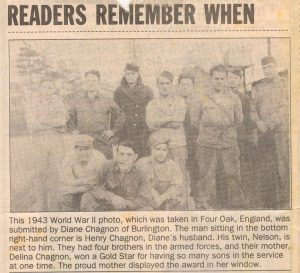
Taking a step back in time with this old Burlington Free Press clipping. Diane Chagnon had submitted a photo of Henry and Nelson Chagnon who are twin brothers, 1943 when they were both along with Clarence, Chester and Roy serving their country in various branches of the armed forces. Their mother Delina (Bouchard) Chagnon had receive a a Gold Star for having 5 sons all serving at the same time.  It is said that she use to have it displayed in her window.

History of the Chagnon Surname

chagnonfamilytree
The family name Chaignon was found in Dauphine, where the family goes back to the time during the era of Humbert II in 1349. The region of Dauphine was one of the States of France. Nestled between in the Rhone Valley and the picturesque Alps. It is from this area that the surname Chaignon is believed to have originated.
The family was well established in the region of the Rhone and several members of the family had distinguished themselves through their contributions toward the community in which they lived and were rewarded with lands, titles and letters of patent confirming their nobility. They branched into Lyon, Paris, and Langeudoc, the Touraine region, in and near the Loire Valley.
Throughout the course of history most surnames have undergone  changes for many reasons. For example, a  son may not have chose to spell his name the same way that his father did. Many are simple spelling changes by a person who gave their version, phonetically, to a scribe, a priest, or a recorder. Many names held prefixes or suffixes, which became optional as they passed through the centuries, or were adopted by different branches to signify either a political or religious adherence.
Most surnames appear to have had some sort of original meaning, usually descriptive, rather than being simply a pleasing collection of sounds. These descriptive names developed both from nouns and adjectives. Examples of name descended from nouns are like the Irish Gaelic names Conan “hound, wolf” and Aed “fire. Irish Gaelic names derived from adjectives also, such names as Fial “modest, honorable generous” and Finn “fair, bright, white.” A more elaborate descriptive naming practice is exemplified in the Bible, when Rachel names her last son Benoni or “son of my sorrow” and his father Jacob renames him Benjamin “son of the right hand”. (Gen.35:18).
As time went on the language changed and in many cases the words that formed the original name passed out of use, leaving the fossilized form in the name. This is why we do not recognize the meanings of many names today, because their origins are in ancient languages. The  translation of the name Chagnon means strength of the Oak Tree.
With the rise of Christianity, certain trends in naming practices manifested. Christians were encouraged to name their children after saints and martyrs of the church. The oldest of these names were Jewish and Greco Roman names. The names of the apostles and other prominent early Christians mentioned in the New Testament were often Jewish, such as Mary, Martha, Matthew, James, Joseph and John. The early Christians, lived in the Roman empire, and it is among the other people of the empire that they first began to convert non-Jews. In  the early centuries, many Greco Roman names entered the Christian name pool in commemoration of the martyrs and saints, such as Anthony, Catherine, Margaret, Mark, Martin, Nicholas and Paul. Several of these early Christian names can be found in many cultures today in various forms.
Surnames developed from by-names, which are additional identifiers used to distinguish two people with the same given name. These by-names tend to fall into particular patterns. These  started out as specific to a person and then became inherited from father to son between the twelfth and sixteenth century. Some of the specific types are: the patronymic (referring to the father or mother), a locative or toponymical (indicating where a person is from), an epithet (which describes a person in some way) or a name derived from occupation, office or status. Out of these types occupational names are often the most obvious in a origin. Baker, Brewer, Weaver, Taylor and Smith are fairly obvious in meaning. Some of these occupational by-names also have feminine versions, which became hereditary surnames. For example, the feminine of Baker is Baxter, the feminine of Brewer is Brewster and the feminine of Weaver is Webster. There are two main reasons why there are so many variant spellings of some names.
First: most of the citizens of the 1600 – 1800’s were illiterate. Only  a precious few could sign their names and very  few were educated beyond what we, today, would consider a basic elementary education. Consequently, many of the clerics & notaries, who under the French system of administration were charged with recording “vital statistics” wrote the names as they knew them to be in France. Hence, we have many variations of the name, Chagnon, some of which are spelt Chaignon, Chaigneau, Chagnard, Chaillon, Chaillons, Chaillont, Chagongne, Chagnont, Chagnons, Chagnart, and Shonyo, but all are included in the basic origin of the surname. The second reason for variant spellings is: as the colonists migrated within New France and eventually beyond the areas of French speaking Canada (ex to current day USA, the Caribbean, the West Indies etc) recorders of “vital statistics” who were not French speakers, usually spelled names phonetically, or changed them because they didn’t have a clue how to write them.
The “dit” names have an interesting origin. The English translation of “dit” is “said”. The Colonists of New France added “dit” names as distinguishers. A settler might have wanted to differentiate their family from their siblings by taking a “dit” name that described the location to which they had relocated to (ex: since the Colonists followed the customs of the French feudal system, land was divided amongst the first born. A few of the dit names that were used for the Chagnon family was Chagnon dit Larose, Chagnon dit Challion and Chagnon dit Lajeunesse.
The preponderance of the names Joseph & Marie, or combinations with such, in the records. (ex. Joseph Charles, Joseph Francois, Marie Jeanne, Marie Margarite, etc.). It was and still is the practice amongst the Catholics of the French & Hispanic cultures (note the number of Jose & Maria amid the Spanish-speakers) to honor Joseph, or Mary, by giving the baptized child the honorary name in addition to the given (first) name.
The French Canadians have slowly & slightly changed the practice by using the honorary names as middle names. All the Franco Canadian & Franco American men who entered the military service, with the name of Joseph preceding their “first name”. The Government reasoned that since it was the first name listed on their baptismal certificate, it was therefore their “legal” first name.

How To Clean and Care For Gravestones

chagnonfamilytree

 Being able to recognize any damage to  a gravestone before  cleaning it can help prevent  more damage from happening and knowing what cleaning methods and materials to use will help in preserving the gravestone.

What are Gravestones made from?

Gravestones are made from some of the finest natural materials on earth. Many of these natural materials are created into beautiful pieces of art by skilled craftsmen.Over the centuries a variety of materials have been used for creating gravestones. The type of material used depended on the era, and what materials were available in the area. Some of the materials used were: marble, granite, sandstone, limestone, bronze and wood.

Different types of gravestones will require different cleaning methods. Marble and Limestone need to be treated  more gently than granite. Where granite can be cleaned every 2-3 years, marble, sandstone, or slate stones should be cleaned  no more than 8-10 years.

Wooden headstones should only be cleaned by an expert. Even if the marker looks stable, you can’t tell if it is weather damaged on the inside  or at its base in the ground.

Cast iron headstones should be cleaned in the same manner as granite gravestones. Do not try to remove rust or flaking metal as it could harm the inscriptions, symbols and icons on the gravestone.

White Bronze (zinc) gravestones  were meant to “weather” so the ionization of the metal should continue to build in the welds and make for a sturdier hold on all joints.

How to Check for  Damage and Cleaning Needs:

Because gravestones are exposed to airborne pollution, such as acid rain, chemical residues from fertilizers, severe weather conditions and mineral deposits from water some maintenance is usually needed.

Gravestones that are in direct contact with the earth are constantly drawing water from the ground and then evaporating it along its surface. This water may have dissolved salts, minerals such as iron and copper and other pollutants.

You should first determine whether or not the stone actually needs cleaning. Many people think that signs of aging are dirt or grime. Marble and other materials do naturally fade over time.

Examine the gravestone for any flaking, scaling, cracks, or eroding granular surface. If you see these signs of damage, you may want to consult with a professional before cleaning. Use extreme caution if you decide to proceed. Cracks are an obvious sign of damage. Any damage can be an indication that the stone is weakened. Avoid putting pressure on the weakened areas. It is better to leave some dirt than to put additional stress on the stone. If there is soiling present, determine the type. Types of soiling could be carbonaceous or sooty soiling, urban grime, dirt, organic-algae, fungi, lichens, mosses, stains-metallic, oils. or efflorescence–salts.

Again, if there is any damage or weakened areas on the stone you may still want to consult with a professional.

Lichens and Fungi:
chagnonfamilytree

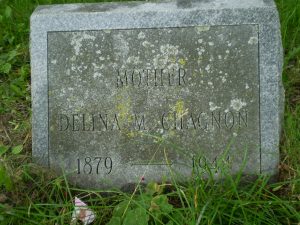
Lichens is the most common to see on a gravestone. Lichens are living organisms that are similar to a fungus. They come in many different colors, such as grey, green and yellow. Lichens can harm gravestones by trapping dirt, organic debris and moisture on the surface of the gravestone. Because gravestones are somewhat porous, the lichens also can trap these contaminants under the surface of the stone. Moss and other molds can also be present, which are  usually caused from weather conditions.

What Tools Are Needed?

Here is a list of suggested tools that are best to use when cleaning gravestones. When using a scraping device it is important that it is softer than the stone. Hard objects damage the outer layers of the gravestone, making it more susceptible to the elements.

Sprayer bottle – Use for wetting down the stone or spot cleaning
Clippers – Use to clean away any grass or weeds.
Bucket With Lid – To store your supplies and used as a seat.
Rubber Gloves – Protect your hands cleaning products.
Nylon Brushes – Use only soft natural or white bristled.
Plastic Scraper –Only use plastic or wood.
Q-tips – Used to get into small cracks.
Sponges – Soft sponges.
Tooth Brushes –To get in small spaces.
Water – Wetting, cleaning with and rinsing
Whisk Broom – To sweep off the stone before cleaning.
Paint Brushes – soft for cleaning engraving, etc
Towels or old T-shirts
Protective Eye ware – Especially if using cleaners or scraping debris

Cleaning Solutions – What Not to Use or Do:

There are many detergents, cleaners that should not be used to clean gravestones, along with tools that can cause damage.

Chlorine bleach  should never be used for cleaning gravestones or monuments. Household bleaches often contain sulfates that may cause exfoliation of the surface of the gravestone  and as these salts dry out and re-crystallize in the pores on the surface. Bleaches can also produce light brown staining after a period of time.
Hydrochloric acid can cause rust staining and the deposition of soluble salts.
Sodium Hydroxide mixed with water forms a caustic soda and can cause the formation and deposition of soluble salts and rust staining.
Fantastic contains 2-butoxyethanol (butyl cello solve), alkaline builders, water, fragrance, and dye. It is not recommended for cleaning any porous or polished surfaces.
Formula 409 contains ethylene glycol, even though a non-ionic detergent, alkaline builders, water fragrance and dye and is not recommended for masonry or polished surfaces.
Spic-n-Span is an abrasive cleaner containing sodium chloride, sodium sulfate, sodium carbonate, sodium bicarbonate and ammonium carbonate. It will form and deposit soluble salts.
chagnonfamilytree

Marble and limestone, for example, are easily dissolved by acidic cleaners, even in diluted forms. Chemicals can react with components in mortar, stone, metals, wood or brick. They can create soluble salts, which can cause a buildup of these salts beneath the surface of the stone eventually causing spalling.

Do not assume that the label of contents is a complete list of all the chemicals contained in a household detergent product.

Tools To Never Use:

Never use metal brushes, metal scrapers, metallic scrubbers or abrasive pads of any type, including, “Brillo” and “Scotchbrite.” Never use a sandblaster or pressure-washer on any gravestone or monument. Never use pressurized water to clean a gravestone or monument. This includes water coming directly from a hose that is under pressure.

What Cleaners Should You  Use Use?

Time and weather can cause a gravestone to look less than pristine. Once you have accessed that your gravestone is dirty and in need of cleaning you will may need to choose a cleaning product. The following is a list of several acceptable cleaners. You may find that water and some gentle scrubbing is all you need and not have use a cleaner at all.

Detergents Non-ionic (e.g., Photo Flo – a Kodak Product, or Trion-X 100) are recommended for cleaning gravestones. They are electrically neutral cleaning agents that do not contain or contribute to the formation of soluble salts. Non-ionic detergents are available from conservation, janitorial, and photographic suppliers. A suggested cleaning solution is one-ounce of non-ionic detergent to 5 gallons of water. Always read the label carefully to ensure that it says “non-ionic”.
Acetic acid (e.g. vinegar) is less aggressive than other acids, solutions have been recommended for the removal of general soiling from limestone. Oxalic acid is not recommended for general cleaning, but is recommended for rust staining removal on light-colored granites, one pound to one gallon of water.
Calcium Hypochlorite (e.g. Chlorine) is effective for the removal of biological growth; mix one ounce to one gallon warm water. Available from swimming pool suppliers. Requires a lot of thorough rinsing with water and Hydrion Paper test strips for pH testing.
Ammonium Hydroxide (e.g. household ammonia) diluted 1:4. is recommended for cleaning light colored stones and is particularly effective for the removal of biological growth. Requires a lot of thorough rinsing with water and Hydrion Paper test strips for pH testing.
Quaternary Ammoniums (e.g. algaecides) are especially effective for the removal of stubborn black algae and biological growth. Also available from swimming pool suppliers.

Weather Conditions:

Before you start, be aware if there is a frost or freeze warning. It will take a period of days, perhaps weeks, for the water to evaporate from the pores of the stone, and surrounding area. Also if it is a hot sunny day, be sure that you constantly keep rinsing the stone so that the cleaner you are using doesn’t not dry on the stone.

How Do You Clean?

You should use some personal protective equipment such as aprons, rubber gloves, shoes; and goggles or face shields, especially if you are using cleaners.

Once you have checked the stone over closely and determined that it is not damaged, and safe to proceed then you are ready to begin the cleaning process. If you are using a cleaner, follow the directions on the label and be sure that it is well mixed with the proper ratio of water.

Start by pre-wetting the stone with water. Pre-wetting prevents excessive penetration of cleaning solutions into the stone and facilitates softening of soiling such as lichens or moss. Wet your sponges in your bucket of water and gently begin wiping down the surface of the stone.

Remove any growth and build up lichens or moss by using plastic scrapers that are soft and flexible and can get the job done without damaging the gravestone.

After you have removed the first layer of dirt or grime, you can use your brushes. Wet the brushes, then use them by gently scrubbing in a circular motion over each part of the stone. It is best to start at the bottom of the stone and work your way up. This will help you to avoid leaving streaks. Keep the brush wet by dipping it into a bucket of clean water or running water from the hose over the bristles. When cleaning carvings and lettering, use a soft bristled toothbrush.

If you feel that water alone is not accomplishing the results you would like, move on to whatever cleaning product you have decide to use. Again remember to clean from bottom to top of stone to avoid streak staining the stone and frequently rinse off the stone with water. (You may want to test your selected cleaner before a general application. Test in a small inconspicuous area and evaluate the results when dry.)

If lichens or moss is a problem, after scrapping you can use an ammonia mixture. Combine one-part ammonia with four parts water. Using a clean sponge, gently scrub the affected area with the ammonia mixture. After you are done, rinse with plain water.

For a more natural method, people have used snails to clean their stones. Snails consume many of the materials that grow on gravestones, such as lichens, mold, and fungus.

After cleaning and rinsing the entire gravestone, wipe it with paper towels or soft cloths to prevent the stone from streaking as it dries. Residues from cleaning solutions can create a blotchy appearance, provide a medium for bacterial action, and cause staining. Do not allow cleaning solutions to dry on a gravestone.

Keep a Record:

Gravestones do not require regular cleaning. Although it might seem natural to want to frequently clean them. You should clean the stone approximately 2-3 years unless it is marble, sandstone or limestone, which should only be cleaned every 8-10 years. Write down the date each time you clean the stone. This will help prevent you from over cleaning.

If the whole process sounds too difficult for you to do, you can talk to the cemetery caretakers and see if they provide any service maintenance plans or if they know of someone that provides professional cleaning service.

When Should You Consult an Expert?

If you have any concerns about the condition of the gravestone, it is a good idea to talk to an expert. For example, an expert will be able to tell you the approximate age of your stone. They will also be able to identify the material of the stone, and be able to inspect it for damage. Contact the cemetery to ask if they can recommend someone you can consult with.

I hope you found this information helpful. If you have any questions, please feel free to contact me.
Tips for Interviewing a Relative- Method of Genealogy Research

One of the methods used in doing genealogy research is through interviewing a relative.  When sitting down with someone and listening to their story through questions that you are asking can be very interesting. There is a lot of information that you can learn from interviewing older members in your family. Your parents, grandparents or even aunts and uncles can be a wealth of knowledge. They may have had the opportunity to meet or even got to know ancestors that you didn’t.  So through their oral recount, you can collect some very good facts.

Story telling has been a tradition in many families and these stories can be filled with a lot of information that you might not be able to find elsewhere.   They add  real emotion and feelings to your family history.

One of the difficult parts of oral genealogy research is that it can’t always be verified.  The person you are interviewing  may or may not be able to give you dates, names  and locations.

As we all know sometimes storytelling can become embellished to make it more exciting or important. That is true with most storytelling.

If you have someone you would like to interview, here are few  tips on  interviewing that may help.

  • Contact the person you would like to interview and set up a time to meet with them. Depending on if you have to travel a great distance, you may want to be sure to set plenty of time with them, so that you don’t have to go back to finish your interview. If you live close by, then you might be able to set up a series of meetings.
  • A day or two before the interview, contact the person to be sure that your meeting is still set. With older people, they sometimes have good and bad days and may not feel up to meeting you at the last minute, so you may  need to reschedule.
  • Depending on the person you are interviewing, it may be helpful for them to have a copy of the questions you are going to ask them in advance. This gives them time to think about things. You may also want to ask if they have any photos or memorabilia that they would be willing to show you in relation to the questions you will be asking.
  • You may want to think of something to give them as a token of thanks for letting you interview them. It can be something as simple as a box of chocolates or a gift card to a local store or restaurant. This will let them know how much you appreciate them and their time.
  • You will need to decide how you will record the information during the interview. Do you plan to videotape it, audio record it or simple take notes? If you plan to video or audio record you will want to check with the person ahead of time to see if they are OK with this method. Some people are very intimidated about having themselves videotaped or audio recorded.  Audio recording can be  somewhat less intimidating.  Either of these two forms of media make a great addition to your family history. The advantage of video or audio is that you capture the image of the person,  their voice,  along with every word, which saves you from worrying about missing information as the person is talking and you are taking notes.
  • Putting together a list of questions to ask helps keep the conversation more in line with the information that you are interested in. Put down as many questions are you can think of. You may not be able to get all of them answered, but having too many questions is better than if you run out and get home to realize that there was other information you should have asked. The list of questions is also helpful when the interviewee begins to stray off the subject. If that happens you can politely bring them back on course with asking the same or another related question.
  • Make sure that the equipment you are using is in good working order. Make a list of what you need to bring, such as power cords, batteries, etc.
  • If you are videotaping it will be important to set up your camera on a tripod. You will need to make sure that you are close enough to the interviewee to get clear audio and have good lighting.
  • It is best if there are as few distractions as possible, such as the TV or a radio playing. Set the camera off to your side slightly so you can control it easily. The person you are interviewing does not have to stare straight at the camera.
  • To start an interview, make sure that the interviewee is comfortable and relaxed. Start with some light conversation and thanking them for taking the time to meet with you. Keep in mind that older people can tire easily, so you may need to take short breaks.  See to it that they have something to drink, especially if they have been talking for some time.
  • Depending on the time that you have set for your interview and the length of the answers given, will of course determine  how many of your questions you will get answered. Put your most important questions  at the start. If the conversation leads to  you thinking of questions that you don’t have on your list, you may want to quickly write them down, so that you don’t forget to ask them.
  • You may want to ask if they have any photos or documentation, etc that they can share with you.  Don’t ask to borrow  them, but instead ask if you can take a photograph with your camera or phone. Older people can be very attached to these types of things and don’t want them out of their possession. Things like war metals, letters, certificates, documents, photos, etc., can help verify the oral information that they are sharing.
  • As  you come to the end of your interview time, you will want to double check your list of questions. You can also ask your interviewee if there is anything  that they would like to add to your family history.
  • Thank them and present them with the token gift you have for them.
  • Be sure that they have your contact information.  They think of something else  and can contact you.

Everyone is different and every interview is unique.  Collecting family history through oral interviewing can be very interesting and very rewarding. Learning about someone’s life on a personal level is an honor.  

Some of the things mentioned here  are pretty obvious, but you would be surprise how things can get over looked. I hope these tips are helpful to you in your genealogy research.  Please contact me if you have any questions.

Wishing you all the besting in your seeking.

A Review on 3 of the Top Genealogy Software Programs.

There are so many choices these days when it comes to creating and organizing your genealogy information. There are websites that offer an online genealogy  services for storing your family tree, for usually a fee. There are a several  free open source software programs out there like Gramps, ScionPC and MyHeritage Family Tree builder,  if you don’t need a lot of features and or are on a tight budget.  Then there is genealogy  software that you  purchase and install on your computer. These come in either a download format or a cd version that is shipped to you.   Of course there still is the old fashion way, which was used before the time of the home computer or laptop, pen and paper.

Well in this article we are going to compare some of the features  of  3 of  the top genealogy software programs  for 2017 that you can purchase and install on your computer. These can be downloaded or shipped.

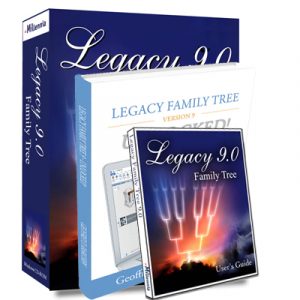
Legacy Family Tree 9 – $34.95-$99.95
Legacy Family Tree is a powerful genealogy program that creates over 25 charts and 20 reports to help you visualize your family line and share your research with others.  It has many tools researching, charting and organizing your family tree. It has an in-app browser that allows you to research your family online directly from the software, and when you find new information, the program can import it directly to your family tree.  Legacy can export and import GEDCOM files offline quickly, which is useful when you work other genealogists.  The program also connects to the web via popular sites like  Ancestry.com, FamilySearch.com, My Heritage.com and Findagrave.com.
In addition to the classic paper charts, Legacy lets you create a full webpage to display your family history. This is a good feature if you are considering starting a genealogy blog or want to share your work with your family.  The index and research tabs come in handy when your family tree starts to get large. The index allows you to access individuals and their information.  It also has an enhance multimedia feature. Errors are flagged with red warning symbols so that you can clearly spot any mistakes that may have been entered. There is  web hints feature in this latest version.

This software is available on CD or as a download. There are also several bundle options. And if you already have an older version you can upgrade for less.  This is compatible with Windows

Legacy is easy to use and they have FAQs section to help answer any of your questions.

Pros: Easy to use, has over 25 charts and 20 reports, has a useful web hints feature to help guide your research.  and can create research forms.
Cons: This program doesn’t give the options to display same sex marriages. However, a planned to rectify this.


chagnon family tree

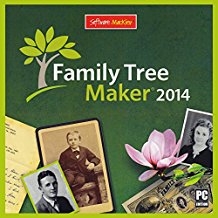
Family Tree Maker  Deluxe  2014– $69.95

Family Tree Maker is a very popular and well known software program.  has a clean and easy to use interface with enough features to help you find and store thousands of family members in one place.  The program guides you through importing and exporting GEDCOM files and creating  charts of your family history.

Family Tree Maker connects to Ancestry.com’s extensive database and community and to MyHeritage.com. One of its optional  star features. Tree Sync, synchronizes the trees you create in the software with your Ancestry.com account. When you make changes in the software, the changes carry over to your online profile.  This is especially useful if you’re a member of the Ancestry.com’s active community. Family Tree Maker is not compatible with FamilySearch, so you can’t search that site directly from within the software.

You can import GEDCOM files into the program. This is the most common file format that software  and online family tree databases use for sharing information between program..

Family Tree Maker give you access to a physical map of your ancestors migrations and origins.  You can view your map in 2D 3D, aerial or road view.

This program alerts you if you enter any information that may be wrong. For example, we if a child’s birthdate is very close to its mother’s or if the mother age is under 13 years old at the time.

You can add same sex marriages in the program.  It is tricky though to connect same sex couples, since the program adds a spouse of the opposite sex by default.  You have to add individuals separately and then connect them as spouses.

Family Tree Maker has 10 types of printable charts and 27 reports. You can these publications to create full books about your ancestry.  Family Tree Maker has an extensive sourcing, reporting and research features accessible through clearly marked tabs. This software comes in  both Mac and PC operating systems.

Pros: The multiple web – enabled features keep you connect to popular genealogy search sites like Ancestry and My Heritage. Does have the ability to enter same sex marriages.

Cons: It does not support in- program searches of FamilySearch.com. Only  has 10 charts. The developer Ancestry has discontinue further updates for this program as of end of 2016.


chagnon family tree

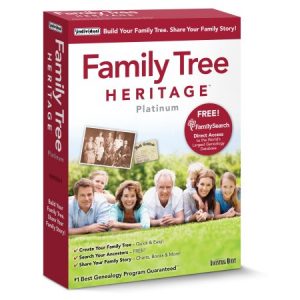
Family Tree Heritage  Platinum 9 – $38.99 – 39.99
Family Tree connects to the top genealogy sites such as FamilySearch, Ancestry and Rootweb.  And you can easily add any genealogy site to this program.
Family Tree has a web hints feature. Adjusting errors in your tree in bulk is one the advantages of this package. Another benefit of this program is the merging of two trees. This is easily done with Family Tree Heritage 9.
A ditto tool is provided that will enable you to attach numerous people to the same source. So this can save you a lot of time when you are citing your records.

It has a user friendly interface. New features color coding to id generations. Offers other more than 20 charts and 15 reports.

There is also no in-app browser, so a separate window is needed when search online. This can lead to confusion when you switch between the two programs.Though it has direct access to FamilySearch.org. The are sold on Amazon.com.

Pros: Great for printing out records, can add any genealogy websites to this program. Offers a free trial so you can test it out before buying.
Cons: no in app browser. Same sex marriages is not supported. You are not able to sync your tree to the web in order to enter any found information.  Comes in Windows or Mac platforms.

There are several other genealogy software programs available. Out of the three that I reviewed, both Legacy Family Tree and Family Tree Maker have lots of the same great features. I feel for the money though, Legacy Family Tree 9 gives the biggest bang for the buck at $39.95. The disadvantage for Family Tree Maker 2014 is it is no longer being updated as of  the end 2016 and it is priced at $69.99. Legacy Family  Tree has  pretty close to the same features as Family Tree Maker, with the exception of  not being able to enter same sex marriages, but they are working on rectifying this with an update soon.  It connects to Ancestry.com,  FamilySearch.org and MyHeritage.com  easily, prints books and wall charts. The Family Tree Heritage 9 doesn’t seem to have an many features though they claim to have more features than any other genealogy program.

Depending on what is important for you to have in your genealogy software for features, I would suggest that you go directly to each of their websites and any other software programs that you may be interested in and check out their full list of features that they offer and then decide.

Hope this info was helpful. Happy Seeking!

History of Names

chagnonfamilytreeThe History of Names is so ancient that no one knows the beginning of the story. Since written history began, and as far back as oral history reaches, people have had names. It is therefore impossible to do more than guess at how the earliest given names were chosen. Most names appear to have had some sort of original meaning, usually descriptive, rather than being simply a pleasing collection of sounds. These descriptive names developed both from nouns and adjectives. Examples of name descended from nouns are like the Irish Gaelic names Conan “hound, wolf” and Aed “fire. Irish Gaelic names derived from adjectives also, such names as Fial “modest, honorable generous” and Finn “fair, bright, white.” A more elaborate descriptive naming practice is exemplified in the Bible, when Rachel names her last son Benoni or “son of my sorrow” and his father Jacob renames him Benjamin “son of the right hand”. (Gen.35:18).

Early in prehistory some descriptive names began to be used again and again until they formed a name pool for that particular culture. Parents would choose names from the pool of existing names rather than invent new ones for their children. As time went on the language changed and in many cases the words that formed the original name and its origins passed out of use, leaving the fossilized form in the name. This is why we do not recognize the meanings of many names today.

With the rise of Christianity, certain trends in naming practices manifested. Christians were encouraged to name their children after saints and martyrs of the church. The oldest of these names were Jewish and Greco Roman names. The names of the apostles and other prominent early Christians mentioned in the New Testament were often Jewish, such as Mary, Martha, Matthew, James, Joseph and John. The early Christians, lived in the Roman empire, and it is among the other people of the empire that they first began to convert non-Jews. As a result of the persecution of the early centuries, many Greco Roman names entered the Christian name pool in commemoration of the martyrs and saints, such as Anthony, Catherine, Margaret, Mark, Martin, Nicholas and Paul. Several of these early Christian names can be found in many cultures today in various forms.

Surnames developed from bynames, which are additional identifiers used to distinguish two people with the same given name. These bynames tend to fall into particular patterns. These usually started out as specific to a person and became inherited from father to son between the twelfth and sixteenth century. Some of the specific types are: the patronymic (referring to the father or mother), a locative or toponymic (indicating where a person is from), an epithet (which describes a person in some way) or a name derived from occupation, office or status. Out of these types occupational names are often the most obvious in origin. Baker, Brewer, Weaver, Taylor and Smith are fairly obvious in meaning. Some of these occupational bynames also have feminine versions, which became hereditary surnames. For example, the feminine of Baker is Baxter, the feminine of Brewer is Brewster and the feminine of Weaver is Webster. There are two main reasons why there are so many variant spellings of some name.

Until the last hundred years or so when the spelling of a surname became standardized, the same person’s surname could be spelled differently from record to record. Before the 19th century, when many people were illiterate. Only an elite few were educated beyond what we, today, would consider a basic elementary education. Consequently, many of the clerics & notaries, who under the French system of administration were charged with recording “vital statistics” wrote the names as they know them to be in France, as a precious few of the immigrants/colonists signed them, or as they heard them (phonetically). Hence, we have many variations of our name, Chagnon some of which are Chagnon, Chaigneau, Chagnard, Chaillon, Chaillons, Chaillont, Chagongne, Chagnont, Chagnons, Chagnart, and Shonyo, but all are included in the basic origin of the surname.  This lead to different spellings for same names. Spelling continued to change and evolve until the beginning of the 20th century when it became fixed, in large part due to the standardization required by Social Security Administration in the United States.  So as you are looking for your surname history, you may consider researching possible spelling variations. Don’t assume your surname was always spelled the way it is today.

In Europe, the first surnames were first used about eight hundred years ago. People developed individual surnames which, over time, became names that were passed down from generation to generation.  Some surnames origins are uniquely created. Scandinavian countries, at first, used non-inheritable patronymic names. Each succeeding generation would have a different last name based on his or her father’s first name. Because of this tradition, Scandinavian countries became standardized surnames much later than other European names. It was only about 100 years ago that people in Scandinavia began to inherit their father’s last surname.  Spanish countries traditionally use two surnames. Generally, the first surname is from the father and the second is from the mother.  Polish countries have gender specific surname endings. If a wife takes a husband’s surname which ends in –ski, her new surname will end in –ska.

“Dit” Names

The “dit” names have an interesting origin. The English translation of “dit” is “said”. The Colonists of New France added “dit” names as distinguishers. A settler might have wanted to differentiate their family from their siblings by taking a “dit” name that described the locale to which they had relocated to (ex: since the Colonists followed the customs of the French feudal system, land was divided among the first born. A few of the dit names that were used for the Chagnon family was Chagnon dit Larose, Chagnon dit Challion and Chagnon dit Lajeunesse.

Preponderance of Names

The preponderance of the names Joseph & Marie, or combinations with such, in the records. (ex. Joseph Charles, Joseph Francois, Marie Jeanne, Marie Margarite, etc.). It was/is the practice among the Catholics of the French & Hispanic cultures (note the number of Jose & Maria amid the Spanish-speakers) to honor Joseph, or Mary, by giving the baptized child the honorary name in addition to the given (first) name.

The French Canadians have slowly & slightly changed the practice by using the honorary names as middle names. All the Franco Canadian & Franco American men who entered the military service, with the name of Joseph preceding their “first name”, were registered as “Joseph”. The Government reasoned that since it was the first name listed on their baptismal certificate, it was therefore their “legal” first name.

There are a number of websites that can tell you the meaning of your surname, such as www.surnames.behindthename.com  or Meaning of NamesMeaning of Names – Browse through over 40,000 names, name meanings, and origins.